

I spent the day before my wedding listening to an audiobook by a divorce attorney reflecting on decades of hearing what people wished they’d understood before their marriages ended.
As I listened, I couldn’t stop thinking about all the different possible futures Anna and I might have together: what could go right, what could go wrong, and what might cause it to fall apart. More than anything, the book made me feel the preciousness of a relationship and how easy it is to lose sight of this. It was the relationship equivalent of the idea of memento mori (roughly, remember that you will die): contemplating the end of your relationship to get the most out of your time together before that unknown end date.
As I thought about the inevitable fact that, one way or another, our relationship will someday end, I wondered: how could I keep this awareness alive in my relationship so that we could make the most of our time together?
To answer this question, I called up my friend, author and speaker Jodi Wellman. Jodi has spent a decade researching how an awareness of death changes our approach to life, and her newsletters are my favorite weekly reading. (Sign up here | Read her book)
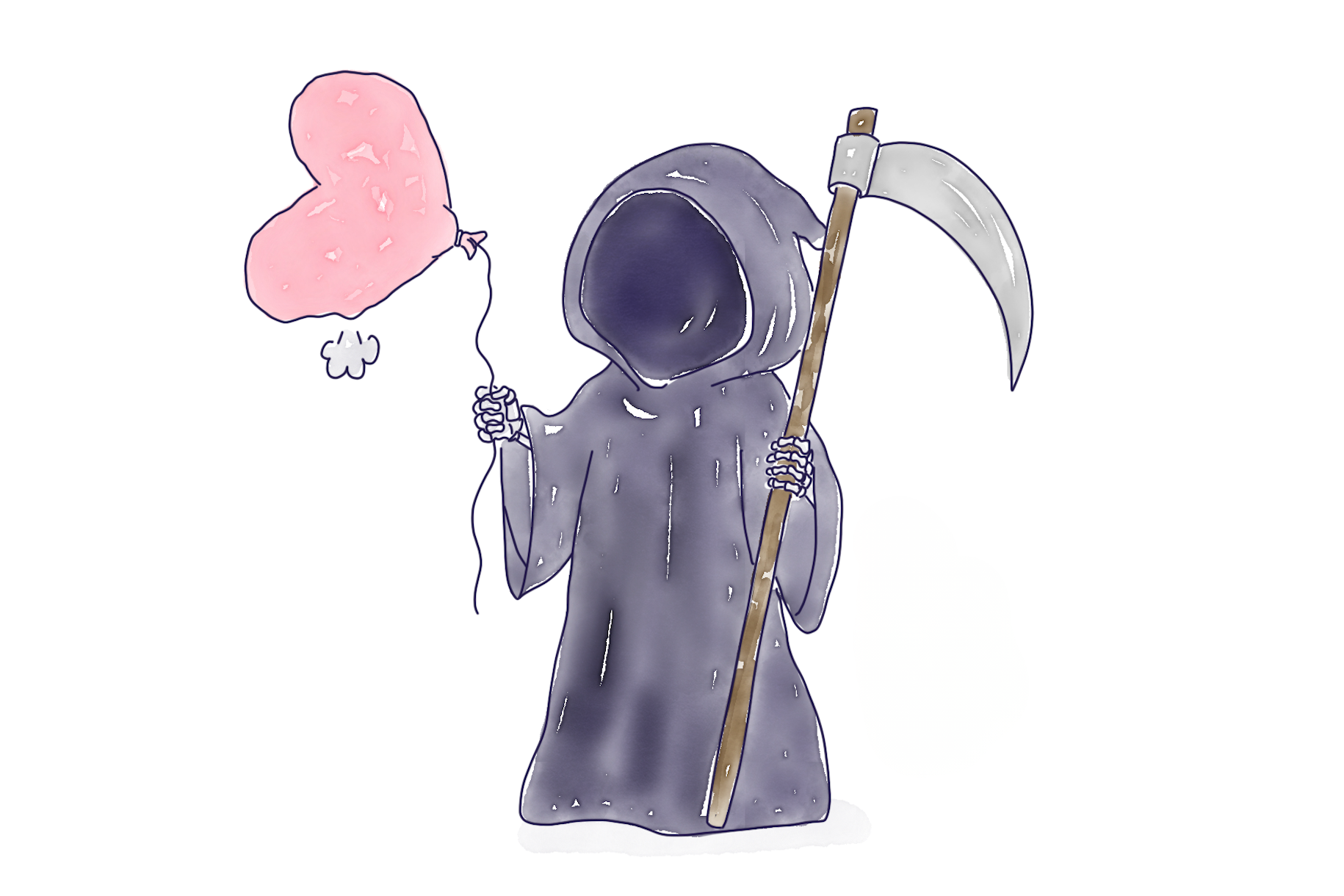
Here are some highlights of our interview, followed by recommendations from the Grim Reaper on how to love better in the time we have together.
The Science of Death
What is your #1 takeaway from your research and writing?
Remembering that we will die doesn’t have to be macabre with a lot of gothy black eyeliner; it can be life-affirmingly clarifying. When we accept that our time is finite, we become far less willing to squander it on autopilot, petty grievances, and lives that look acceptable on the outside but don’t feel alive on the inside.
How do relationships and an awareness of our mortality interact?
Mortality awareness helps us remember that relationships aren’t permanent fixtures; they’re limited-edition experiences. Memento mori (remembering we must die) can prompt us to express the love, gratitude, apology, or truth we keep assuming we’ll have time to say later.

How do we balance memento mori with planning for the future? In other words, YOLO vs. paying the bills?
The goal isn’t to blow your retirement savings on a llama farm because death is coming. It’s to prepare responsibly for the future without repeatedly sacrificing the only life you can actually experience—the one happening right here, right now. (And if a llama farm is on your bucket list, please make that happen, pronto.)
You write about how habits can blunt our aliveness. How does that show up in relationships?
Our brains are designed to automate the familiar, which is fabulously efficient but not especially enlivening; we stop fully noticing what we see, do, and even whom we love every day. In relationships, this can turn a fascinating human being into part of the household furniture, unless we deliberately reintroduce attention, novelty, curiosity, and appreciation. If I want to stop seeing The Husband as an ottoman, I just have to plan an interesting date night.
Advice from the Grim Reaper
So, other than buying that long-awaited llama farm, how can we put the Grim Reaper to work?
I think the best way to do this is to make the ending concrete, and then reflect on what might change.
1. Make the ending concrete
Research by Stanford psychologist Laura Carstensen suggests that when people perceive time as limited, their priorities change. We focus more on emotionally meaningful experiences and relationships, and less on goals that may pay off someday.1
So what happens when we make the possible end of a marriage concrete? Based on my analysis of 2024 Census data, someone in a first marriage of 5–9 years has roughly a 1 in 52 chance of getting divorced over a one-year period.2
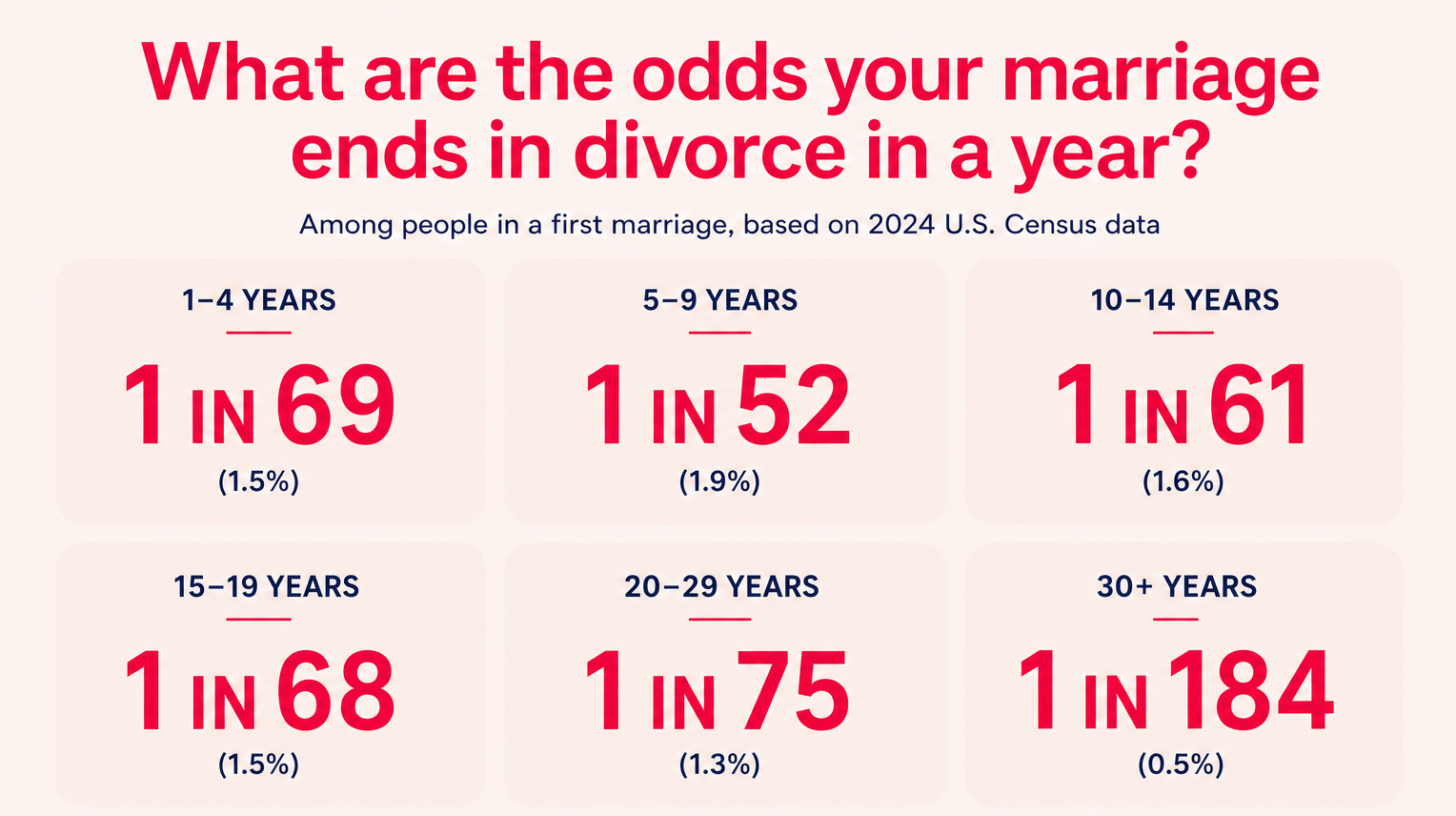
Statistics can’t predict your marriage, but that’s not the point. The point is that it is easy to take for granted that our relationships will continue simply because they always have. Contemplating how much time we might have left, rather than how much we’ve already had, can remind us to make that time count.
2. Reflect with your partner
Imagine you somehow knew that one year from today would be your last anniversary together. What would you do differently over the next year? What would you do exactly the same? What would you do more of?
When you’ve had a chance to reflect on the preciousness of your relationship, each commit to one change to get the most out of your time together…however long that may be.
The Grim Reaper isn’t particularly romantic. But perhaps remembering that our time together will end is one way to remember just how special it is.
Carstensen, L. L. (2021). Socioemotional selectivity theory: The role of perceived endings in human motivation. The Gerontologist, 61(8), 1188–1196. https://doi.org/10.1093/geront/gnab116
Carstensen, L. L. (2006). The influence of a sense of time on human development. Science, 312(5782), 1913–1915. https://doi.org/10.1126/science.1127488)
While the median marriage lasts 12 years, a more useful approach comes from actuaries. Just like knowing how many more years you are likely to live is more interesting than knowing how many years an average person lives, we can calculate how many years you likely have left in your marriage based on how long you have been together.
I put this together with an analysis of the U.S. Census Bureau’s 2024 American Community Survey 1-year Public Use Microdata Sample (PUMS). Estimates include people who reported having married exactly once and compare recent divorces with first marriages still at risk, grouped by approximate marriage duration. These population averages should not be interpreted as predictions for any individual marriage.