

During Q&A for one of my recent talks on “Relationships By Design” I got a fascinating question: what about our relationship with ourselves? Isn’t that the most important factor in how our relationships with others go?
I found it hard to disagree and speak from deeply personal experience.
I’ve wrestled with depression my entire life. In my lowest spirals of depression, poor sleep, and unwise health choices, I am unable to engage meaningfully in my relationships, or even to seek support and care from others. If you’ve battled depression as well, I’m sure this is all too real.
To truly receive and engage with other people, you have to fight your battle against your most harmful thoughts. About eight years ago, I learned of a powerful technique to do this.
Essentially, the exercise is to write down, examine and challenge your most common looping thoughts. I did this intensively over a one-week span when I was near my lowest, ultimately writing down over 150 thoughts that had been looping through my mind on repeat for months.
Here are some examples, in my own words:
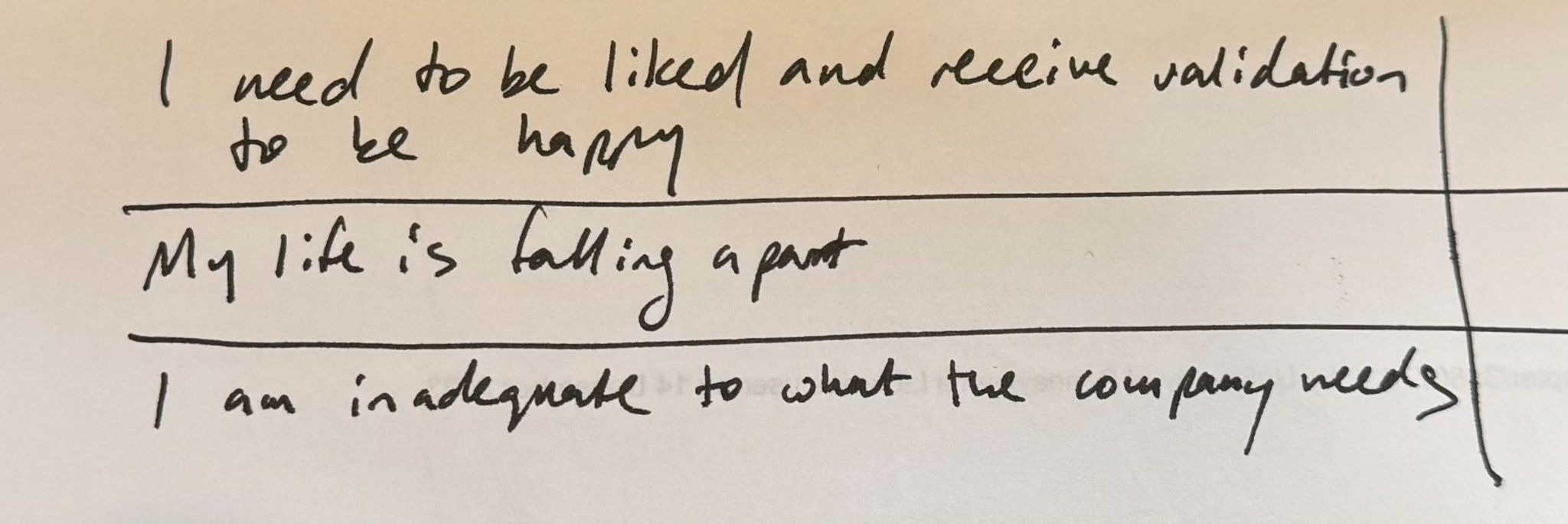
You’ll probably notice what only became clear when I read aloud the words I was saying to myself: my relationship with myself was harsh, fatalistic, and unforgiving. This in turn made it very difficult for me to see the good in others or receive the support I so badly needed.
There’s a reason some people say you can’t love another person until you love yourself. To keep your external relationships healthy, be sure to occasionally take a good look at how you speak to yourself, and how you’d like to change that.
Talking To Yourself
The way we talk to ourselves is thoroughly studied in the field of cognitive behavioral therapy (CBT), a major breakthrough in psychology dating back to the 1960s.1 While it is a broad topic, one key insight of CBT restates an element of Stoicism and Buddhism: our thoughts create our world.2
CBT practitioners make the relationship between our thoughts and our reality concrete through the A-B-C model: an Activating Event (A) triggers a Belief (B), which has Consequences (C) in the form of behavioral choices or emotions.3

For example, this is what the A-B-C model looks like for one of the thoughts I wrote down in my journal pictured above: I am inadequate to what the company needs:
Activating Event: Someone unexpectedly quits their job at my company
Belief: I tell myself they quit because I believe “I am inadequate to what the company needs”
Consequences: I feel even more anxious and I have a hard time focusing at work
The goal of this approach is to analyze your thinking, understand its effects and change the consequences by refining the belief. Crucially, the idea isn’t to leap to positive thinking that is unrealistic, but to reach more accurate thinking that you can believe at least as much (if not more) than your original belief.4
As I engaged in CBT and started writing down my thoughts more often, I learned to slow down the doom loop of harmful thoughts. I tried examining my original thoughts, identifying the distortions within them, and re-writing those thoughts in a more accurate way:
Original Thought: “I am inadequate to what the company needs because someone just unexpectedly quit.”
Distortion: “I am jumping to the worst possible conclusion and disqualifying the positives I bring to the company.”5
More Accurate Thought: “The person quitting has often been a challenge to manage, and their decision to leave is not necessarily because of me. While I don’t feel like I am excelling, I am still making a positive impact in several ways. In fact, one of my team members thanked me just last week for my hard work improving the company.”
In just a few minutes of reflection, I turned a fatalistic, overly simple perspective into a nuanced one that better reflects reality. On a deeper level, doing this thoughtfully can help us unwind the harmful stories we hold onto about our own self-worth.
So, how can this technique help in a relationship?
Name Your Stress, Don’t Become Your Stress
Negative self-talk can strike hardest at times of stress,6 and if we’re not careful, it can lead to us turning on our partner. This isn’t just a “nice-to-have” item: one study found that couples helping each other to process and manage external stress in a non-judgmental way was the most important trait among couples who maintained relationship health multiple years after going through therapy.7
So, if you have been through a rough patch (and who hasn’t??), a key to staying on track going forward is in how you help each other manage external stressors.
Let’s talk about how you and your partner can do this in your relationship.
Helping Each Other With Your ABCs
What you can do to ask for help: Signpost to your partner that you want their support with a thought that you are wrestling with and share it using the A-B-C model. Here’s one I’ve faced recently:
Activating Event: A colleague laughed and said, “Oh, you’re just a pup getting started in your relationship.”
Belief: I thought, “I have been married too few years to be taken seriously working with and writing about relationships.”
Consequence: When I believe this, I feel demotivated, insecure, and choose easy tasks instead of useful ones.
How you can help your partner: When your partner is wrestling with doubt, self-loathing or self-criticism, you can help them to reframe their thoughts in a fairer light. But many couples get this wrong because they jump to problem solving, when the key is to provide a balance of empathy and shifting perspective.8 I cannot emphasize this strongly enough: too much empathy and we get stuck ruminating about the situation;9 too much perspective and we don’t feel a sense of security, connection or belonging.10 Problem solving, by contrast, is rarely what people want.11

First, just listen to your partner for at least 5 minutes, only interjecting with expressions of care, support, and validation of their emotions and the difficulty of the situation.
Second, ask questions that help to provide perspective. Perspective questions are things like:
What will matter the most in 12 months?
How might your values guide your decision in this situation?
How have you dealt with similar situations in the past?
What would you advise a friend to do in a similar situation?
Here’s to supporting a better relationship with yourself so that your relationship with each other can be even better. Cheers!
Beck, A. T., & Dozois, D. J. A. (2011). Cognitive therapy: Current status and future directions. Annual Review of Medicine, 62(1), 397–409. https://doi.org/10.1146/annurev-med-052209-100032
Or in a lighter vein: Don’t believe everything you think!
The reality is actually more complex, as both our emotions and our behaviors can also create our thoughts, but I like the simplicity of this model. It’s not the only tool in the CBT toolkit, let alone psychology more broadly, but it’s a powerful one.
The fact that the new thought is as much if not more believable is the crucial part. This is why it is so frustrating when someone tells us we should look at the positive side of things…if it’s not believable to us, it likely just makes the original thought even stronger.
There are a number of lists of common cognitive distortions or thinking traps, which I find quite helpful to refer to when a particularly nasty thought won’t leave me alone.
Here’s one list:
Jumping to conclusions
Magnifying and minimizing
Personalizing
Externalizing
Overgeneralizing
Mind reading
Emotional reasoning.
You can see longer descriptions here: https://simplifaster.com/articles/high-performance-library-resilience-factor/
Source: Reivich, K., & Shatté, A. (2003). The resilience factor: 7 keys to finding your inner strength and overcoming life’s hurdles (Nachdr.). Broadway Books.
Sladek, M. R., Doane, L. D., & Breitenstein, R. S. (2020). Daily rumination about stress, sleep, and diurnal cortisol activity. Cognition and Emotion, 34(2), 188–200. https://doi.org/10.1080/02699931.2019.1601617
Gottman, J. S., & Gottman, J. M. (2015). 10 principles for doing effective couples therapy. W. W. Norton & Company.
See Kross, E. (2021). Chatter: The voice in our head, why it matters, and how to harness it. Crown.
This is known as co-rumination: Rose, A. J. (2002). Co–rumination in the friendships of girls and boys. Child Development, 73(6), 1830–1843. https://doi.org/10.1111/1467-8624.00509
Also, see Bushman, B. J. (2002). Does venting anger feed or extinguish the flame? Catharsis, rumination, distraction, anger, and aggressive responding. Personality and Social Psychology Bulletin, 28(6), 724–731. https://doi.org/10.1177/0146167202289002
Taylor, S. E. (2006). Tend and befriend: Biobehavioral bases of affiliation under stress. Current Directions in Psychological Science, 15(6), 273–277. https://doi.org/10.1111/j.1467-8721.2006.00451.x
Here are the seven reasons that people share their emotions with someone else. Notice where advice shows up!
1. Clarification and meaning
2. Rehearsing
3. Venting
4. Arousing empathy/attention
5. Informing and/or warning
6. Assistance/support and comfort/consolation
7. Advice and solutions
Source: Duprez, C., Christophe, V., Rimé, B., Congard, A., & Antoine, P. (2015). Motives for the social sharing of an emotional experience. Journal of Social and Personal Relationships, 32(6), 757–787. https://doi.org/10.1177/0265407514548393