

“How could they say that to me?”
We’ve all said this. Every so often, you just end up in a conversation with your someone that just stuck in your craw1 and you can’t let go.
For me, it was one small comment from my then girlfriend over 20 years ago. She told me that while she thought I was smart, talented and creative, I would never be successful because I was unable to focus.
That stuck with me for the rest of our relationship. It was hurtful coming from anyone, but especially from someone I expected to have my back. But, looking at it now, as with many things we struggle with in life, it wasn’t actually that bad. If I could have just let it go, we both would’ve been happier.
Because the truth is, that girlfriend also said lots of nice things about me. And I’m pretty sure that she didn’t mean I would be a failure in life. She likely thought, not unreasonably, that I could benefit from being more disciplined and focused, but she just said it in a clunky way that picked at my insecurities.
The tough reality of relationships is that they involve a ton of letting go. Even the happiest couples get heated from time to time, and we all say things we regret, especially to the people we love most. So if we do this ourselves, why is it so hard to let go when our partner does it? What can we gain if we assume positive intent and let bygones be bygones?
The Science of Letting Go
Research says that we struggle to let go due to lack of closure or resolution. Take a trip to Vienna with me.
In 1927, psychologist Bluma Zeigarnik was observing waiters at a busy Austrian cafe and noticed something interesting. The waiters could take orders from a large table of customers and relay it flawlessly to the kitchen staff without writing anything down. Rather than focusing on how much these waiters could remember, however, she wondered, when do they forget?
It turns out the answer was pretty much immediately. Zeigarnik discovered that, once a waiter had passed an order to the kitchen staff, they almost immediately forgot the order details.
This led to what came to be known as The Zeigarnik Effect: the idea that our brains are wired to spend more time on unfinished tasks than on finished ones. Specifically, Zeigarnik found that people could recall unfinished tasks 90% better than finished ones.2 Relationship scientist John Gottman has said that this is the most likely candidate for why some relatively small things can stick with us for years: because they are unresolved.3 It is likely that the more “unfinished events” that we let stick around, the more ruminations we will have about the relationship, which may cascade into much bigger problems.4
Taking the Pebble out of Your Shoe
To be clear, what I am about to say applies to smaller events, like a stray comment or a small mistake, not deeper betrayals or traumas. Those wounds definitely require a skilled therapist.5
But let’s talk about the small things that we just can’t let go of. My favorite metaphor for these sorts of incidents is that they are like a pebble stuck in our shoe.6 While we think these little things are harmless, just as a pebble can lead to a painful blister over time, small annoyances can cause a great deal of distress.
So, why don’t we just pause and take the pebble out? After years of personal experiences, therapy training, and psychology research, I’m convinced that we don’t speak up about these small things that bother us because it is hard to do it artfully. It may seem foolish to litigate a small comment shortly after the fact, especially when it makes us feel emotionally agitated. It’s easy to imagine picking up that small frustration leading to an unnecessary fight.
But this inaction only compounds the problem. We are more likely to regret the times we failed to take action than the times when we did speak up.7 And that inaction is what turns a small thing into a big frustration.
After surveying the different tools for “clearing the air” in these situations,8 I decided to build something that captured the keys to settling issues with someone we care about in a way that keeps the conversation productive using something we’d all recognize: our hand.
The High-Five Clearing
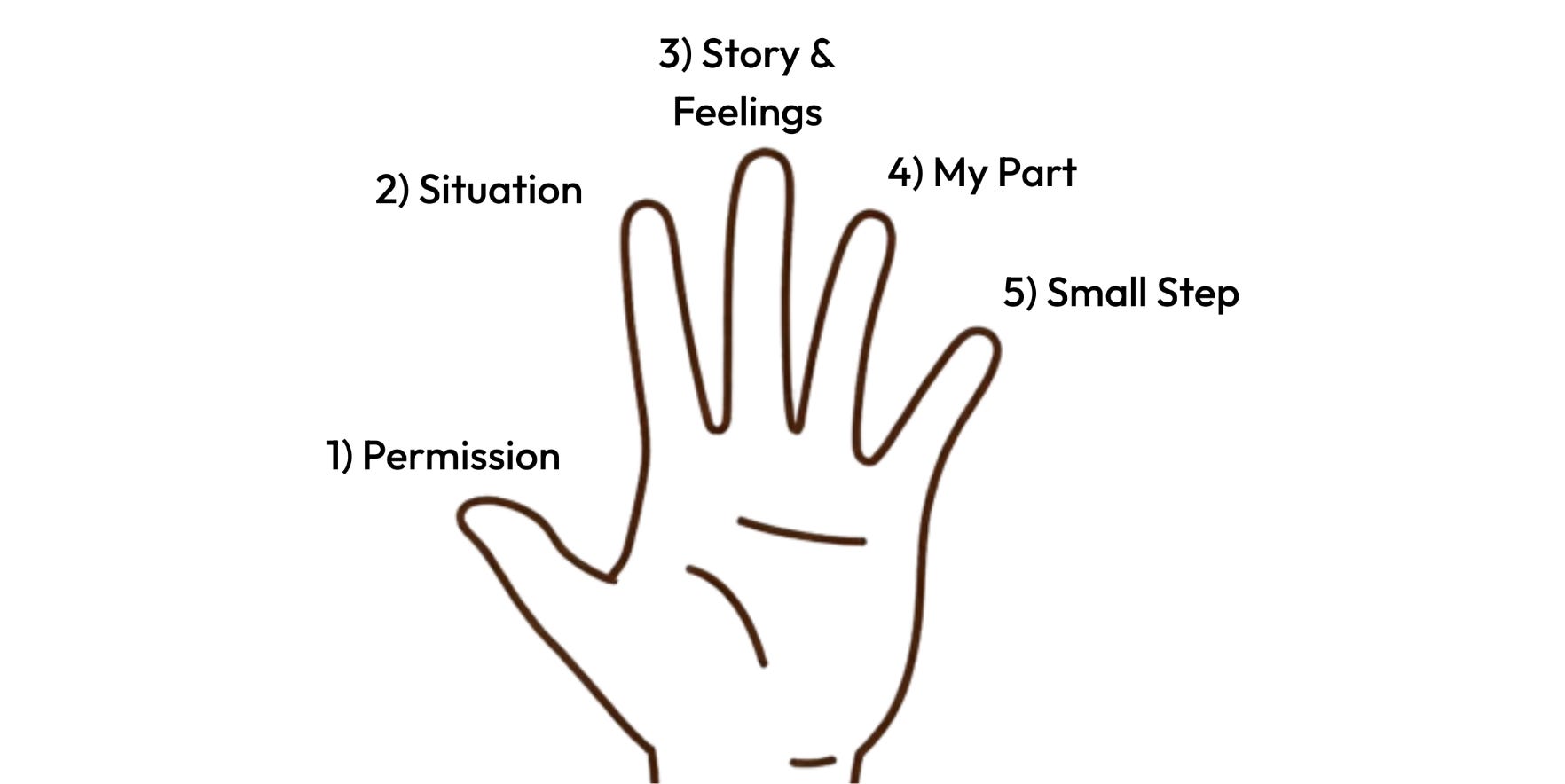
👍 Thumb. Because I really care about our relationship, I’d love to have a short conversation. Is now a good time? (If not, find another time!)
👆 Pointer Finger. This situation that I’d like to talk about is: <1-2 sentences describing what happened>
🖕Middle Finger. This affected me because: “<the story I’m telling myself> which led to <2-3 feelings>”9
💍 Ring Finger. (Because I care about our relationship) my part in this situation is: <1-2 sentences>
🤙 Pinky Finger. 1 thing I am requesting that we can do to make it better right now is: <an apology, a hug, a change in behavior, a conversation about a topic, etc.>
Here’s what this might sound like:
Permission: “Because I love you, I’d like to have a short conversation about something that happened last week. Would now be an okay time?”
Situation: “The situation I want to chat about is yesterday morning when you engaged Ian him around plans for his birthday party as I was trying to get him out the door.”
Story and Feelings: “I have a story that the parents who show up late to school are doing a kind of ‘walk of shame’ and are the mediocre parents everyone else is judging. I end up feeling embarrassed when I show up at school and anxious throughout the run up to getting out the door.”
My Part: “My part in this is that I haven’t shared my feelings or how important being on time is to me, and I’ve probably been pretty passive-aggressive when this situation comes up.”
Small Step: “I would really appreciate it if we could agree to prioritize getting him out the door on time in the mornings and save conversation topics and non-essential things for the evenings or weekends. I will commit to sharing when I am starting to feel anxious instead of being passive-aggressive and affirming that we are a good team together. Would that work for you?”
3 Common Mistakes to Avoid In The High-Five Clearing
Don’t ramble: It’s hard, but really try to stick to 1-2 sentences per finger. Less is more.
Don’t forget to take responsibility (the ring finger): Relationships aren’t 50/50, they are 100/100. It’s very hard to engage with someone who won’t be vulnerable and admit responsibility for their part in a situation. It doesn’t have to be a big thing, just more than zero.
Don’t get stuck on “the facts”: we all live in our own subjective world, and we can quickly get lost trying to argue about what actually happened (easy to dispute) instead of its subjective impact on us (very hard to dispute).
Give it a try and let me know how it goes! It’s a lot more fun to walk around without the pebbles in our shoes.
Do you know what a craw is? I didn’t. Apparently it’s the stomach of a person or animal and comes from the Middle Dutch crāghe or Middle Low German krage ‘neck, throat’. You’re welcome.
More recent research implies that it’s not exactly the unfinished goal that is the problem, it’s the lack of a specific plan to address it. And that once we have that plan we both are more likely to accomplish the goal and we waste less time thinking about it.
See Masicampo, E. J., & Baumeister, R. F. (2011). Consider it done! Plan making can eliminate the cognitive effects of unfulfilled goals. Journal of Personality and Social Psychology.
Gottman, J. M. (2011). The science of trust: Emotional attunement for couples. W. W. Norton & Company.
For a fascinating journey into the world of mental ruminations, see Ethan Kross’s concise and excellent book on the topic: Kross, E. (2021). Chatter: The voice in our head, why it matters, and how to harness it. Crown.
Sue Johnson, Makinen, J. A., & Millikin, J. W. (2001). Attachment injuries in couple relationships: A new perspective on impasses in couples therapy.Journal of Marital and Family Therapy, 27(2), 145–155.
Oh wait, that’s a simile. I can hear my fifth-grade teacher correcting me now.
Savitsky, K., Medvec, V. H., & Gilovich, T. (1997). Remembering and regretting: The Zeigarnik effect and the cognitive availability of regrettable actions and inactions. Personality and Social Psychology Bulletin, 23(3), 248-257.
Credit to Non-violent Communication, Kaley and Nate Klemp, Terry Real, John and Julie Gottman, and the EO Forum Community, among many others who seem to have landed upon the same general truth.
I find the middle finger to be quite evocative of the core point - that our feelings and stories are what give our thoughts propulsion and are why this situation is challenging - but I strongly recommend only using it as a device to remember as opposed to flashing it at your partner!