

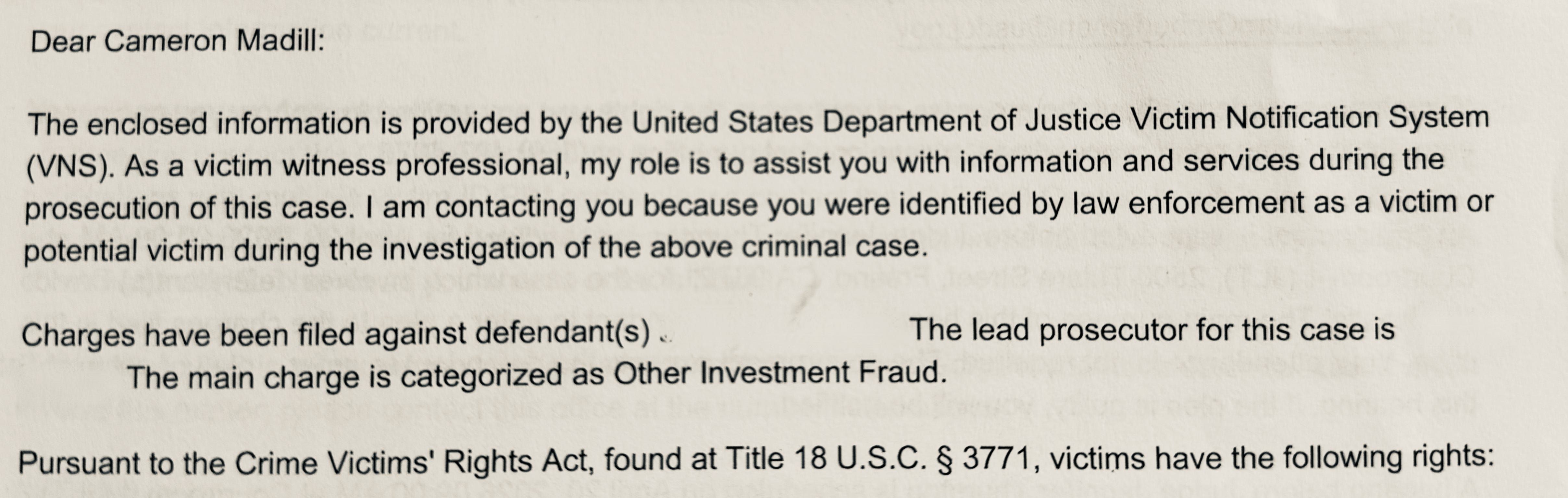
In March I received a letter from the U.S. Department of Justice about one of the largest investments I’d ever made. The letter informed me that I was “identified by law enforcement as a victim…of the above criminal case…categorized as Other Investment Fraud.”
I had confidently made this investment, and watching it unravel was truly painful. I wanted so badly to hide this from Anna.
Losing all that money hurt, but what hurt even more was having to admit to Anna that I had screwed up.
So, how can we keep the inevitable financial ups and downs from damaging the relationship we need to navigate them together?
The science of money and love
What stood out to me in the research on relationships and finances was that one of the biggest threats to a relationship is less about what happens with our money and more about what we can’t see or won’t talk about.1
Researchers call this kind of secrecy “financial infidelity,” where one partner is engaging in financial behavior expected to be disapproved of and intentionally failing to disclose it.2
Financial infidelity is surprisingly common, with one study finding that 27% of participants had kept a financial secret from their partner, and those who experienced it reported lower life and relationship satisfaction.3 The consequences seem to be worse when one partner hides substantially more than the other.4
Of note, for business owners and their significant others, financial transparency can be even more challenging because business and household finances overlap, and income and net worth are extremely volatile.5
To summarize all this research, I would argue that healthy couples make the invisible parts of their financial lives visible to each other.
So, how can couples create more transparency in their financial lives without increasing judgment?
Look below the waterline
So, while we know that money can create a lot of stress, I think we need more useful advice than “communicate better.”
At the core, we need to learn how to create more visibility. So, the first step is to ask each other, where do I feel in the dark about our money? This can be on the level of facts (what you earn, save, and spend or where your assets and debts are) or beliefs (the meaning of money), and it is a great topic for your annual relationship checkup.

At the level of facts, here are three opportunities to explore:
Discuss how you could create greater integration. The complicated nature of modern finances naturally leads to separate accounts (e.g., a company-specific retirement plan). One study found that newlyweds who were advised to merge their financial accounts had higher relationship satisfaction and were less likely to divorce than couples with separate accounts.6
If you have a financial advisor of any type, consider meeting with them as a couple. One study of over 10,000 bank clients found greater alignment in risk tolerance among couples who met together with their financial planner.
If one of you owns a business, ask: “What about the financial relationship between the business and our family is not as clear as it should be?”
When we think about beliefs, research has identified four underlying “money scripts,” or underlying beliefs about money that are most common in individuals:7
Money avoidance: money is bad or taboo
Money focus: a passion for getting and spending more money
Money status: money determines self-worth and should be displayed
Money vigilance: an alertness leading to a focus on saving vs. spending
Ask each other, which sounds most like me and which sounds most like you? How and where do differences show up in our beliefs?
With money, what can sink us is not what’s above the waterline, but what we didn’t look for underneath it.
A study of over four thousand families found that the association between divorce and debt was explained by conflict over the debt. In other words, it’s not just about the debt; it’s about how couples experience it.
Dew, J. (2011). The association between consumer debt and the likelihood of divorce. Journal of Family and Economic Issues, 32(4), 554–565. https://doi.org/10.1007/s10834-011-9274-z
Garbinsky, E. N., Gladstone, J. J., Nikolova, H., & Olson, J. G. (2020). Love, lies, and money: Financial infidelity in romantic relationships. Journal of Consumer Research, 47(1), 1–24. https://doi.org/10.1093/jcr/ucz052
Jeanfreau, M., Noguchi, K., Mong, M. D., & Stadthagen, H. (2018). Financial infidelity in couple relationships. Journal of Financial Therapy, 9(1). https://doi.org/10.4148/1944-9771.1159
These couples were more likely to have individual financial goals, which are associated with worse overall financial health and reduced relationship satisfaction.
Nikolova, H., Olson, J. G., & Gladstone, J. J. (2026). Financial infidelity asymmetry predicts couples’ financial and relationship well-being. International Journal of Research in Marketing, 43(2), 362–382. https://doi.org/10.1016/j.ijresmar.2025.07.003
Shane, S. A. (2008). The illusions of entrepreneurship: The costly myths that entrepreneurs, investors, and policy makers live by. Yale University Press.
Olson, J. G., Rick, S. I., Small, D. A., & Finkel, E. J. (2023). Common cents: Bank account structure and couples’ relationship dynamics. Journal of Consumer Research, 50(4), 704–721. https://doi.org/10.1093/jcr/ucad020.
See also: Gladstone, J. J., Garbinsky, E. N., & Mogilner, C. (2022). Pooling finances and relationship satisfaction. Journal of Personality and Social Psychology, 123(6), 1293–1314. https://doi.org/10.1037/pspi0000388
Broihanne, M.-H., & Orkut, H. (2026). Financial risk tolerance within couples of retail bank clients. International Review of Economics & Finance, 105. https://doi.org/10.1016/j.iref.2025.104828
What’s fascinating is that all of these beliefs could be harmful in excess, and that couples who have similar money scripts were found to communicate more effectively about money together.
LeBaron-Black, A. B., Li, X., Wilmarth, M. J., Suxo-Sanchez, S. C., Archuleta, K. L., Yorgason, J. B., & Kong, D. (2025). Happily ever affluence: Dyadic analysis of money scripts, financial communication, and relationship satisfaction. Journal of Social and Personal Relationships, 42(7), 1415–1438. https://doi.org/10.1177/02654075251327316