

This is a hard thing to admit so I’ll just say it.
More often than I am proud of, I find myself sitting with my young son and being bored, wishing that I was somewhere else.
It’s not because I don’t enjoy spending time with my son! Rather, it’s because, no matter what I am doing, my head is often drifting away to something I’m working on. I often obsess over these professional projects that I’m not fully present with people that I love and care about. I just wish I was working.
This is a huge problem for entrepreneurs in particular. When I interviewed 100+ couples where one or both were entrepreneurs, I heard repeatedly that the entrepreneur’s passion for their work1 often took a toll on their relationship. Partners would say things like this:
“We don’t have a lot of time together. If he’s not fully putting his time into his company, he gets into something else. He makes time for me. But he doesn’t slow down well.”
“She’s always looking for something new, and there’s never a break. She always wants to grow vs. maintaining where we are at.”
“He’s working all the time. It’s hard to get him away from the computer to do something else. The biggest challenge is to get him to disconnect because his mind is always going.”
As I reflected back on my own life and my guilt, I began to wonder if this fixation was always a bad thing. While we often throw labels on this like workaholism, ADHD, or selfishness,2 maybe a passion for work can be simply neutral, or even good?
As I dug into this possibility, I discovered there was a lot to learn about passion and how it crosses domains of life. This learning has become the heart of what I believe is a different way for couples to think about their partnership, mutual support, success, and thriving.
How Our Passions Impact Our Relationships
First, I learned that there are multiple definitions of passion. Here is the best umbrella definition I found of passion: something that you identify with, spend a lot of time on, value as an activity, and generally enjoy.
That is not a bad thing. And that definition doesn’t imply that passion is necessarily disruptive to a relationship. In fact, my study of entrepreneurial couples reached the same conclusion. While the quotes I shared above demonstrate the strain a passion for work can put on a relationship, I heard plenty of examples where that entrepreneurial passion seemed to be positive:
“I want to be good at the few things I can focus on. One of those, being a good husband. Manage time well, manage energy well…always leave something in the tank for home.”
“I would just add that my purpose is to help people, that shows up at work, I talk to my kids, I bring that to our relationship. [I want to be a] strong community member, family member, neighbor…[I’m] always trying to find that balance.”
I can’t imagine trying to build a life where I am less passionate about work. And while that passion can yield bad outcomes, it can also lead to vitality, flow, and creativity in all areas of my life. Passion, like most powerful feelings in life, can be positive or negative, depending on the context.
This led me to what is known as the Dualistic Model of Passion. This framework tells us that passion comes in two primary forms:
A Harmonious Passion that feels chosen by us and amplifies multiple parts of our lives. This is the entrepreneur whose passion for helping people grow makes them a supportive partner and parent.
An Obsessive Passion that feels like it controls us and is only associated with success in that domain. This is the entrepreneur who never takes a night off because they always can find another thing to do at work.
I came to see these two types of passion as like water (harmonious) or ice (obsessive) because of how they interacted with other parts of our lives.

For example, a harmonious passion for an activity is associated with improved performance and better relationships (among other benefits). In contrast, an obsessive passion is associated with improved performance, but at the cost of greater odds of burnout, emotional exhaustion, anxiety, and even problematic behaviors like gambling.3 And, indeed, in my research on almost 400 entrepreneurs, this is exactly what I found: both types of passion were associated with improved business success, but obsessive passion was associated with lower relationship satisfaction, and harmonious passion was associated with higher relationship satisfaction and life satisfaction.
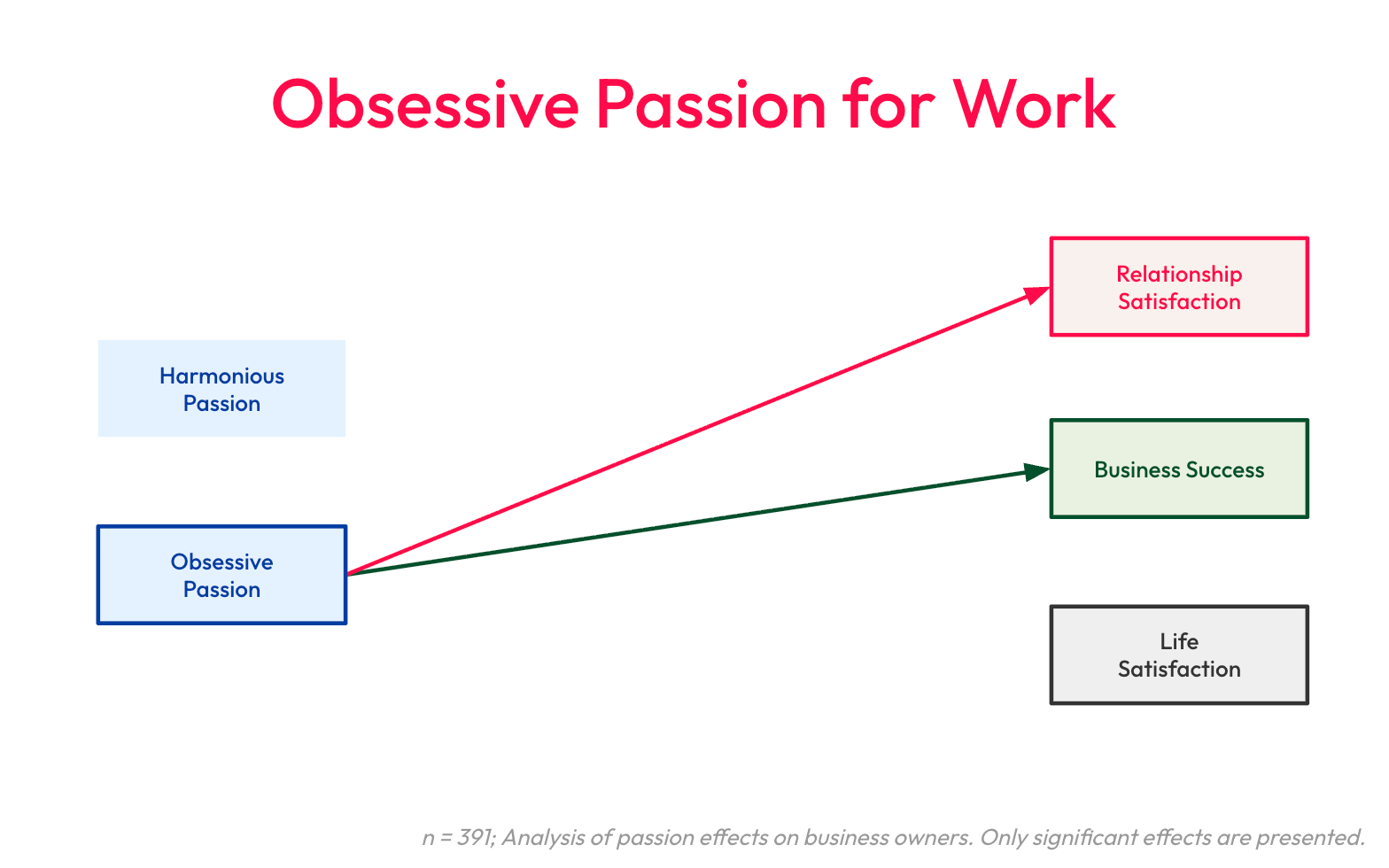
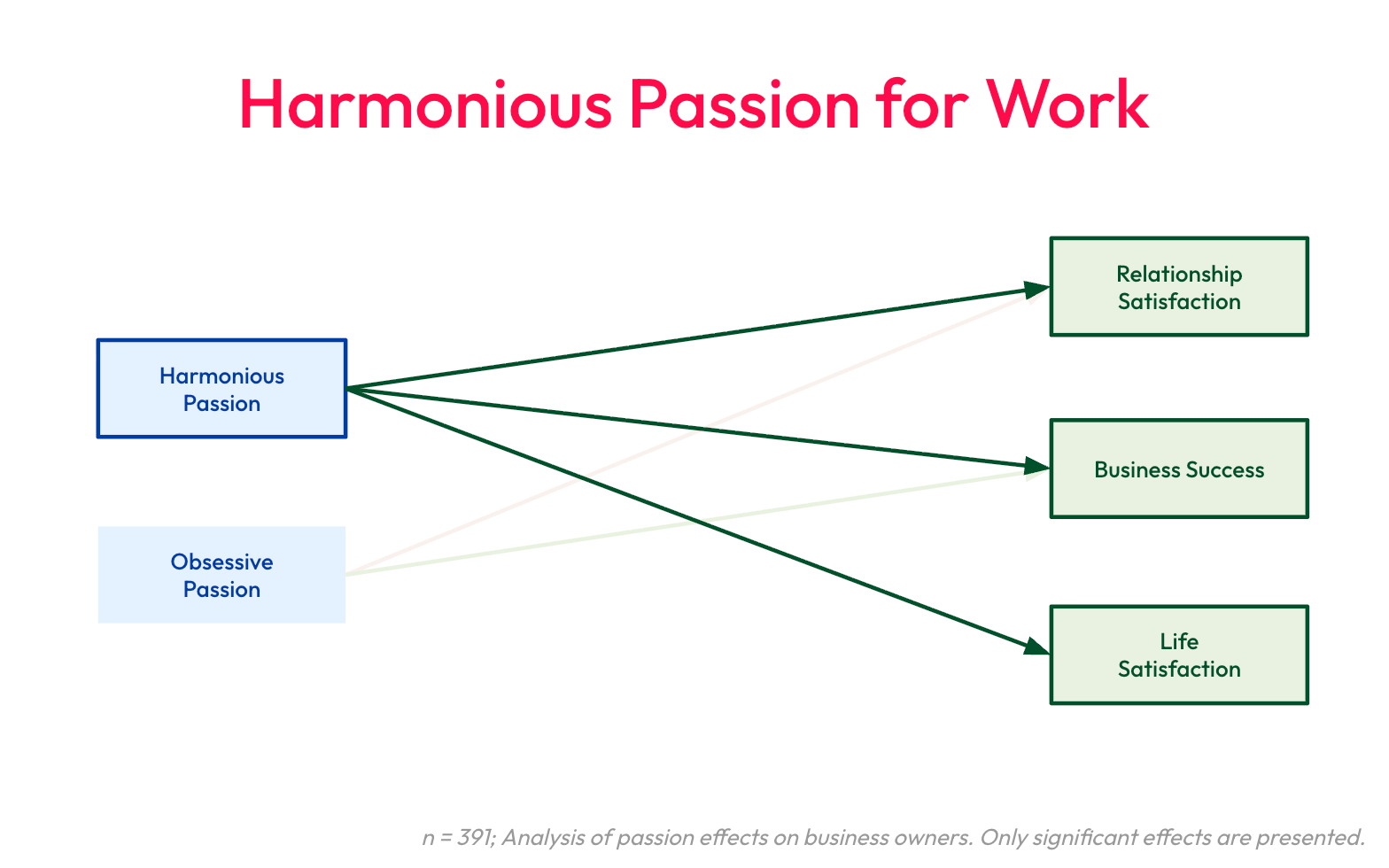
I came to see the struggle to balance a demanding, high-pressure job with a relationship as coming down to one question: how can we build or strengthen a harmonious passion for work so that our passion supports our relationship, other areas of life, and our business, rather than simply powering our professional life?
Making Passion Work for You and Your Relationship
How might we develop a more harmonious passion for work, for the benefit of our relationships, our own well-being, and the long-term sustainability of our work?
The crucial component to finding this positive passion is the feeling of choice. When we feel like the desire to work is controlling us, it is likely obsessive; when it feels chosen, it is likely harmonious.
So how can we best facilitate work feeling like a choice? Here are 3 fun ideas:
Couples discussion: Have coffee or tea as a couple and talk about how to strengthen what you like about yourself at work. This can include traits and strengths, something you don’t want to lose, or personal values that make work meaningful to you. Then ask:
What is one small thing you can do to strengthen these positive traits at work?
What is one small support my partner could provide that would make work better for you?
Expressive Writing: Journal for about 10 minutes a day, 3 days in a row, reflecting on when work feels like a choice and when it feels compulsive. This is known as expressive writing, and it has numerous benefits.4
Discuss your “Unicorn Space.” One of the biggest indicators of obsessive passion is not getting our needs met in other areas of our lives. Your partner likely struggles to support your work behaviors if they feel their needs in your relationship are going unmet. As a powerful exercise: talk about what it would be like for each of you to have one personal passion that is not productive, family related, or professional. As author Eve Rodsky says, “when we stop doing things we feel interested in, we stop feeling interesting.” What better gift could you give your relationship than support for a personal passion of your partner’s that makes them feel interesting?5
While I’d like to say that I’m fully present all the time with my son, the reality is that I still occasionally lose myself in my passion for work. But the more I can accept this passion as a strength which needs to be channeled, the more I feel able to feed that passion at the right time, while also prioritizing time with my son.
Here’s to a life of more passion: for each other, for things you love, and for work that matters.
A fair bit of research supports entrepreneurs being higher in passion for work than most people, which makes sense because running a business is HARD, whatever the other benefits are.
Cardon, M. S., Gregoire, D. A., Stevens, C. E., & Patel, P. C. (2013). Measuring entrepreneurial passion: Conceptual foundations and scale validation. Journal of Business Venturing, 28(3), 373–396.
Thorgren, S., & Wincent, J. (2015). Passion and habitual entrepreneurship. International Small Business Journal: Researching Entrepreneurship, 33(2), 216–227.
Note: it certainly might be these things! But I also think our society tends to be a bit reckless at labeling people without a professional diagnosis, and the labels often cause us to miss the inherent strengths in these conditions.
Harmonious passion is also associated with more flow states in the activity and greater physical vitality! Vallerand, R. J., & Verner-Filion, J. (2013). Making people’s life most worth living: On the importance of passion for positive psychology. Terapia Psicológica, 31(1), 35–48.
Pennebaker, J. W., & Smyth, J. M. (2016). Opening up by writing it down: How expressive writing improves health and eases emotional pain (2nd ed.). Guilford Press.
In her excellent book, Fair Play, Eve Rodsky makes the point that “when we stop doing the things we are interested in, we cease to feel interesting.” And how can we have a thriving relationship if we don’t feel interesting ourselves? In her work, which is focused on splitting up domestic tasks equitably via a card deck of common tasks, she insists that the one card that neither partner can give up is their “unicorn space,” a passion they pursue which is purely done for the love of it.