

When I was 17, I received a big, red envelope offering me admission to Stanford. After waiting for a couple of weeks, I sent in my acceptance letter and began to dream about my future.
A few weeks later, I was catching up with an adult mentor who had played a parent-like role in my life. I was walking on air and couldn’t wait to share the good news.
But I wasn’t prepared for their response: “I’ve never met anyone who went to Stanford that I actually liked.”1
It was like the air going out of a balloon. All the excitement and possibility that I had been seeing for my future evaporated, and I spent much of the next several weeks resenting the comment, doubting my choice, and worrying I had made a mistake by withdrawing from the other schools to which I had applied. I was like a plant that had been hoping for the warmth of the sun but got shoved into the shade.

We all want our partner to be the sun, not the shade. How can we be sure to do the same for them?
Have You Heard The Good News?
For decades, relationship science focused on how we respond to bad news. We all need someone to be our rock when times are tough, so the ability to respond calmly but supportively to bad news was believed to be one of the most important qualities in a partner.
But two decades ago, four researchers decided to study how different people respond to good news. They found a true breakthrough: positive and active responses to good news often predicted relationship health better than responses to bad news!2
Isn’t that something?
There are four ways to respond to good news from your partner. Only one way fuels your relationship: Active and Constructive. You want to stop what you’re doing, be present with the person, tell them how happy you are for them, and ask them questions about what happened.
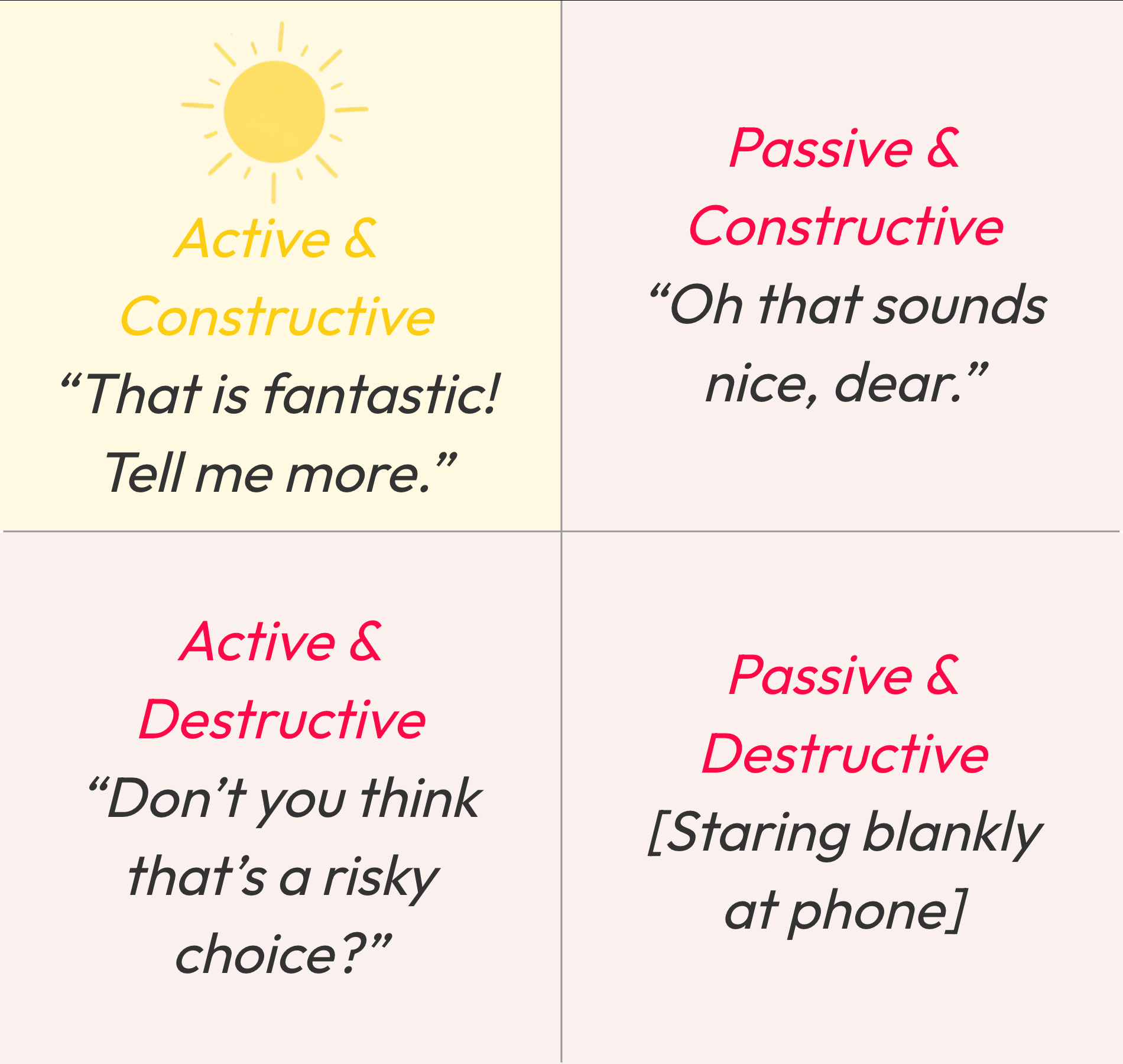
In addition to improving relationship health, constructive and active engagement…
Leads to more positive emotions, less negativity, and greater life satisfaction for the partner.3
Predicts life satisfaction and vitality,4 as well as better relationship quality for both parties.5
Is associated with less depression in children6 and more positive emotions for parent and child.7
In other words, be the sunshine, not the shade. Let’s talk about how.8
How To Be The Sunshine
When I tell people how important it is to be the sunshine in their relationships, the most common objections are the following:
“I’m not a positive person by nature, so being so positive feels inauthentic.”
“Sometimes I don’t think the news is good and the person is missing something concerning.”
“I am usually just too busy to give full attention to things like this.”
These objections are all rooted in a common misunderstanding: you can respond to someone’s joy without being bold, loud, and effusive. There are many ways to be positive in response to someone’s joy, and most people can find a way that is authentic to them.
Try Different Hats
I like to think of this like trying on different hats. It usually looks weird at first, but if you push past that unfamiliarity, over time you will start to feel comfortable.
Here are five very different ways to be the sunshine for your partner. I often ask couples to commit to trying one of these “hats” on each week to stretch their range.
Give a loud exclamation of support (“That’s so amazing! Tell me more!!”)
Ask about the positive implications of the event (“That’s great. What is the most exciting part for you?”)
Ask about the meaning of the event for your partner (“I know how important this is to you. What’s the most meaningful part of this for you?”)
Ask how their strengths or values might have contributed (“I’m really happy for you. How did you get this over the finish line?”)
Ask about the emotions your partner feels when thinking about the positive event (“That’s great to hear. How do you feel?”)
Remember: Caution Isn’t Always Needed
If one of your strengths is caution, you are likely really good at seeing what can go wrong in situations. People with this trait often struggle to suppress their urge to share a potential drawback, even if they are genuinely happy for the person. Often, this comes from a place of love: the cautious person wants to protect their partner from harm and can’t hold back because of that fear.
The key thing to be aware of in these cases is that the sunshine isn’t just about making the person feel good in the moment: it’s also critical to building trust. If a person feels they can confide in you when things are going well, that indicates they are more likely to be able to trust you when things are hard.9 If you rain on your partner’s parade, they won’t come to you when they need an umbrella.
So if someone gives you great news and you feel the urge to point out a potential issue, stop and say to yourself “now’s not the time for concern. I can always share that later.” Give them an uninterrupted moment in the sun and save the questions or concerns for later.
A Minute To Win It
Finally, there’s the busyness objection. You might be thinking, how can I possibly have the time for one more thing? My response: you really don’t need to spend much time at all. In the military — not exactly the most warm and fuzzy of places — they have a phrase that it just takes “a minute to win it” to create these benefits for a team, even when stress is high. It really doesn’t take much time to give your partner the sunshine response they need, and everyone can spare a minute.
What is one way you can be the sunshine for your partner this week?
In fairness, we can be pretty annoying! Some alumni even write articles mentioning their alma mater in the first paragraph.
Gable, S. L., Gonzaga, G. C., & Strachman, A. (2006). Will you be there for me when things go right? Supportive responses to positive event disclosures. Journal of Personality and Social Psychology, 91(5), 904–917.
Gable, S. L., & Reis, H. T. (2010). Good news! Capitalizing on positive events in an interpersonal context. In Advances in Experimental Social Psychology (Vol. 42, pp. 195–257). Elsevier. https://doi.org/10.1016/S0065-2601(10)42004-3
Gosnell, C. L., & Dascano, K. (2023). Effects of the coronavirus pandemic on perceived capitalization support provision and receipt. Social and Personality Psychology Compass, 17(9), e12824.
Peters, B. J., Reis, H. T., & Gable, S. L. (2018). Making the good even better: A review and theoretical model of interpersonal capitalization. Social and Personality Psychology Compass, 12(7), e12407.
Fredrick, J. W., Mancini, K. J., & Luebbe, A. M. (2019). Maternal enhancing responses to adolescents’ positive affect: Associations with adolescents’ positive affect regulation and depression. Social Development, 28(2), 290-305.
Griffith, J. M., & Hankin, B. L. (2021). Affective benefits of parental engagement with adolescent positive daily life experiences. Journal of youth and adolescence, 50(10), 2036-2051.
My mom likes to point out that this is a flawed metaphor since many plants thrive in the shade and struggle in the sun. To which I can only say, I’m sorry, Mom!! If you’ve seen my gardening abilities, you will understand why maybe I should stay away from plant metaphors.
Gable, S. L., Gosnell, C. L., Maisel, N. C., & Strachman, A. (2012). Safely testing the alarm: close others’ responses to personal positive events. Journal of personality and social psychology, 103(6), 963.